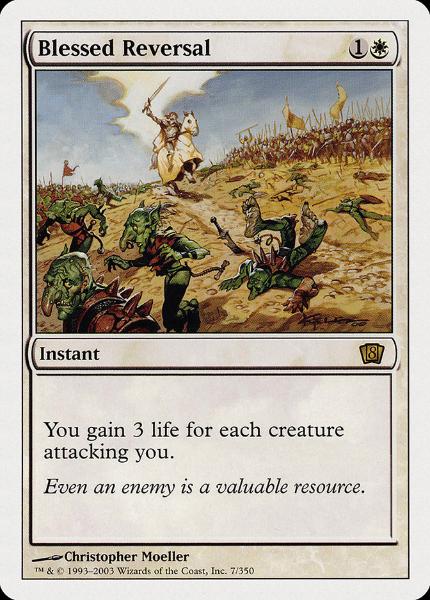
The first thing to notice about this card is that it will only be substantially effective against a force of petty creatures - It would be an ideal method of countering a token deck. That renders it sideboard material. So, if you thought that you needed a strong defense against a quick aggro deck, for example, this might easily give you the edge you need. It can work much like a Fog, allowing you to swing out, take an onslaught of retaliation without getting hurt, and perhaps, take another swing for the win. I find that a fundamental tactic such as this is not useful as often as it should be, given how fast the aggro decks can be, and knowledge of the real game isn't even relevant, if you can just win with something like the new red powerhouse, Torbran. Such imbalanced factors render many good cards useless, and naturally, the game becomes condensed to a very small set of cards within the sets. Allowing a card like Torbran to dictate the rest of the cards in the most effective red decks, for example, greatly restricts compatibility within a design. Rather, if no card were truly dominant, designs would be open-ended, as they should be. There might be a myraid of permutations for a particular sort of design that functioned well enough to consistently win games. Things seem to have gotten more extreme in later sets, and this card from Eighth Edition would likely no longer be considered - But, in truth, that would not be evidence of progress. When people are too weakly minded to learn to use cards that require more orchestration and strategy than to simply play out powerhouse combos, an ignorant majority rules, and destroys an essential foundation of philosophical integrity. |